

Because of the Covid-19 pandemic’s impact on the entertainment industry, one question that has repeatedly come up is “Why don’t movie studios buy theatre chains like AMC or Cinemark or Cineworld (which owns Regal), etc.?” After all, the exhibition industry has seen a huge drop in their share prices & market value, which could potentially be a steal for a major movie studio. In addition, the Trump administration recently abolished the Paramount Decrees, which prevented movie studios from buying theatre chains in the past. Now that the Paramount Decrees have ended, studios are legally allowed to own and operate movie theatres, albeit after a short 2-year “sunset period”. So, why haven’t we heard reports of one of the major studios (Disney, WB, Universal, Sony, Paramount) or even one of the streaming giants (Amazon, Apple, Netflix) lining up to own movie theatres? Well, there are a few reasons…
Even though such a vertical integration idea might sound good on the surface, in reality, it would be a poor financial decision for movie studios to make. Because of declining ticket sales, coupled with lackluster financials for movie theatres and a big emphasis on streaming, studios should not open up their wallets to buy movie theatres.
Declining Domestic Ticket Sales
For starters, domestic ticket sales have been declining for years now. Even though 2019 was a record-breaking year for Hollywood with over $42.5 billion in sales, actual tickets sold were far lower from their early-2000 highs, as seen below.
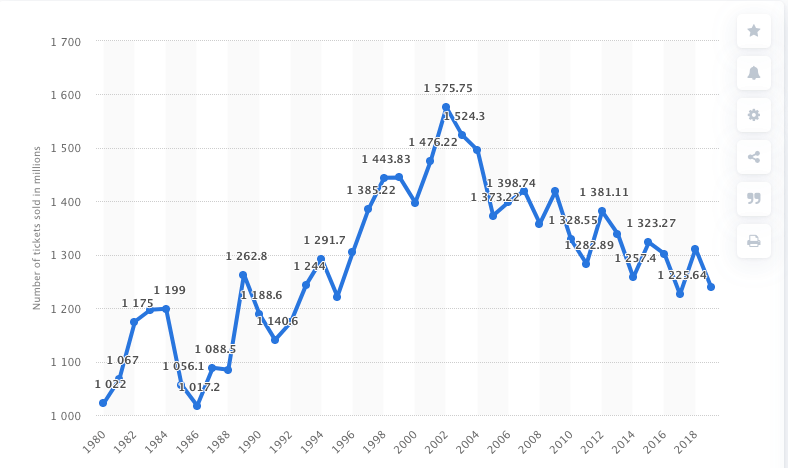
In 2019, 1.244 billion tickets were sold, a drop from 1.301 billion tickets sold in 2018, which is already much lower from 1.575 billion tickets sold in 2002. The only reason 2019 was a record-breaking year, in terms of revenue, is because the average ticket price increased by 36 cents to $9.37. As ticket prices keep rising, fewer people go to the movie theatre, which compel exhibitors to further raise ticket prices to offset the losses. Thanks to burgeoning ticket prices and plethora of other entertainment options like streaming, video games, etc., the average person now only goes to the movie theatre a couple of times a year, primarily for big tentpole films like an ‘Avengers’ or ‘Star Wars.’ In 2019, more than 1/4th of the worldwide box office total came from just 10 movies. The fact of the matter is that people don’t go to the theatre anymore to see smaller films like ‘Doctor Sleep’ or ‘The Lighthouse’, something they routinely did in the past.
Financials
Looking at the financials of AMC, Cinemark, and Cineworld, it is clear that the industry does not have a *high* profit margin. Based on the company’s reported income statements –
Cinemark’s annual net income was: $216 million in 2015, $254 million in 2016, $263 million in 2017, $213 million in 2018, $190 million in 2019.
AMC’s net income was $104 million in 2015, $112 million in 2016, net loss of $487 million in 2017, $110 million in 2018, and a net loss of $149 million in 2019.
Cineworld’s net income was $75 million in 2015, $82 million in 2016, $101 million in 2017, $213 million in 2018, and $141 million in 2019.
While Cinemark and Cineworld have performed considerably better than AMC, at least when it comes to net income, all 3 major theatre chains have billions of dollars in debt (both short-term & long-term).
Not to mention, owning and operating movie theatre is an extremely expensive endeavor. Movie theatres have high overheard fixed costs and because of the pandemic & the resulting lockdowns, they’ve burned through 100’s of millions of dollars of cash every quarter. AMC, the largest theatre chain in the world, recently issued a dire warning, stating that it was going to run out of cash by January. If a studio were to acquire one of these chains, especially AMC, they’d also have to assume all the debt. The 2 biggest movie studios, Disney & AT&T-owned WB, are already riddled with billions of dollars of debt from their recent acquisitions. In 2019, Disney shelled out $71.3 billion to buy 20th Century Fox’s assets, while AT&T purchased DirectTV for $67 billion (including debt) and Time Warner for $85 billion in 2015 and 2018 respectively. An argument could be made, however, for a streaming company to buy movie theatres. As I detailed in my last article, however, Netflix is already $17+ billion in debt, so they are pretty much in no position to run movie theatres & assume all the debt. On the other hand, Amazon ($1.5+ trillion market cap as of this writing) and Apple ($2.2+ trillion market cap as of this writing) have billions of dollars in cash and could potentially acquire movie theatre chains. Even though paying a few billion dollars to acquire one of the 3 big chains is chump change for the likes of Amazon or Apple, both are already investing heavily on their streaming platforms and more importantly, are facing anti-trust lawsuits. It’s safe to say that the last thing either of the 2 tech giants needs is more government scrutiny over its alleged monopolistic business practices.

Streaming
As alluded to before, the industry, as a whole, is transitioning more towards streaming. Today, consumers have over 8 major streaming services, with tons of content to watch from the comfort of their homes. With high-quality, cinematic-level shows produced like ‘The Mandalorian’ or ‘Game of Thrones’ on TV, coupled with all the upcoming ‘Marvel Studios’, ‘Star Wars’ and ‘Lord of the Rings’ shows coming on streaming platforms, many consumers feel like they’re already getting their money’s worth on streaming without having to spend $15 to watch a VFX-heavy movie in a theatre. For less than $15 a month, consumers get access to 1000’s of classic & original TV shows and movies, which is a better deal for an individual.
In addition to all the classic content, consumers also get new movies on the streaming platforms, including films like Wonder Woman 1984 or Soul or Mulan, etc. Recently, WB dropped a bombshell on the industry, announcing that it will have a simultaneous release strategy for its entire 2021 film slate. Meaning, you will be able to watch films like Kong v. Godzilla, The Suicide Squad, Dune in theatres AND on HBO Max on the same day. In the past, studios and exhibitors had a 3-month theatrical window, which meant that studios couldn’t release their movies on Video On Demand (VOD) or on streaming within that 3-month window. If more studios make similar moves, it’ll render movie theatres useless.
I genuinely hope I’m wrong and will happily eat crow if movie theatres come back stronger than ever, once vaccines are rolled out to the masses. If AMC is unable to raise more money through stock issuance or debt and does end up declaring (Chapter 11) bankruptcy in the next few weeks, which is likely, I hope they are able to successfully reorganize their debts and get back in the business. I cherish the theatrical, moviegoing experience and would like nothing more than to go back to the movies again. Yes, there is also an argument to be made that studios need theatres for their movies to make billions of dollars, which is simply not possible on a streaming service. An ‘Avengers: Endgame’ isn’t going to make $2.8 billion on a streaming service or on VOD. However, the costs of buying and operating movie theatres are far greater than the returns and based on the current trajectory, I suspect that going to the movie theatre might eventually become a relic of the past, with a very niche audience.
Conclusion
As I laid out above, I don’t think it would be prudent for movie studios to own and operate movie theatres. Fewer people were going to the movie theatres today than before, even before Covid-19 wreaked havoc on the exhibition industry. With a razor-thin profit margin & a shifting entertainment landscape to streaming, it simply does not make (financial) sense for a movie studio or a streaming platform to spend billions to acquire movie theatre chains.






















 Naman's Movie reviews